
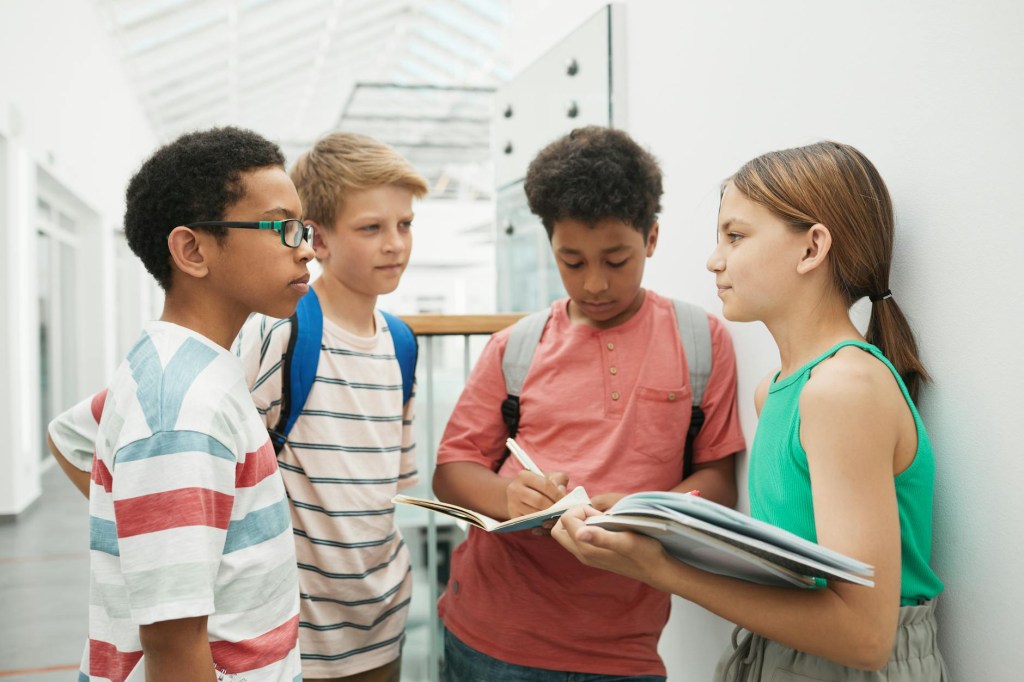
The World Cafe is an active learning strategy that sparks conversation and deepens understanding through rotating group discussions. Participants move from table to table, posing and responding to questions about a central topic. This dynamic format fosters diverse perspectives, collaboration, and critical thinking.
Materials:
- Large sheets of paper: One for each table group, plus several extras for capturing ideas.
- Markers: Multiple colors to differentiate groups.
- Sticky notes: For individual contributions and brainstorming.
- Central question or topic: Clearly defined and engaging.
- Table prompts or guiding questions: Specific questions for each round of discussion.
Procedure:
- Preparation (10 minutes):
- Arrange desks or tables into clusters of 4-5 participants.
- Place a large sheet of paper and markers on each table.
- Write the central question or topic prominently on a whiteboard or chart paper.
- Prepare table prompts or guiding questions for each round of discussion.
- Round 1: Introduction & Exploration (15 minutes):
- Participants stay at their assigned tables.
- Each person introduces themselves and shares their initial thoughts on the central question.
- Facilitate a group discussion using the table prompt or guiding question for this round.
- Encourage active listening, diverse perspectives, and note-taking on the large paper.
- Round 2: Table Hopping & Sharing (20 minutes per round):
- All participants move clockwise to a new table.
- Each newcomer shares key points from their previous group’s discussion.
- The new group uses this information to build upon their own conversation, addressing the same prompt or question.
- Continue table-hopping and sharing for multiple rounds, allowing ample time for discussion at each station.
- Wrap-up & Synthesis (15 minutes):
- Participants return to their initial tables.
- Each group reflects on their learnings and identifies key insights or themes from all the discussions.
- Facilitate a final sharing session where each group presents their main takeaways to the class as a whole.
- Capture key ideas on a central whiteboard or chart paper.
Differentiation:
- Grouping: Form groups based on prior knowledge, learning styles, or interests.
- Tiered Word Banks: Provide word banks with varying levels of complexity for students to choose from.
- Question Scavenger Hunt: Hide questions in the room at different difficulty levels for students to find and answer.
- Choice in Response: Allow students to choose their preferred format for responding.
Technology Integration:
- Interactive Whiteboard: Use the whiteboard to display the World Splash and allow students to add their ideas electronically.
- Poll/Survey Tool: Use a live polling tool to gather student predictions and understanding in real-time.
- Online Collaboration Platform: Create a shared document or workspace where students can contribute to the World Splash collaboratively.
 Teachers Get Active About Learning